Cross-product platform Delivered product work
Building one platform experience across three products
A unified customer experience across a post-merger product portfolio, without rebuilding the underlying identity infrastructure.
Delivered
Overview
Following a merger, customers were navigating three previously separate product experiences, each with its own identity system, authentication flow, and application structure. The goal was a cohesive platform experience for existing and future customers across the combined portfolio. This was a first-of-its-kind cross-product initiative.
- Context
- After a merger, customers moved between three separate products, each with its own identity system and sign-in flow.
- My contribution
- I owned the strategy and roadmap, and championed a facade approach instead of a full authentication rebuild.
Problem
The fragmented experience created friction for customers who needed to move between products.
The ideal long-term solution involved deeper platform and identity consolidation, but we did not have the engineering resources to build a new authentication layer or replace existing systems. A full rebuild would have expanded scope, increased risk, and delayed customer value.
What established the problem
- Existing user journeys across the products.
- Separate authentication models and account structures.
- Available engineering capacity.
My contribution
What I did
- Owned product strategy and roadmap for a complex cross-product initiative.
- Led discovery into existing user journeys, authentication models, and account structures.
- Drove alignment across product, design, engineering, analytics, and test.
- Championed the facade approach as a practical alternative to a full authentication rebuild.
- Established phased MVP scope and sequencing, deciding what to unify now and what to defer.
- Led the initiative through implementation and delivery.
Who I worked with
- Product
- Design
- Engineering
- Analytics
- Test
Decisions & tradeoffs
Delivery phases
Unified foundation
- A unified brand experience across the products.
- The initial rebranded product experience.
- Foundational product and architectural decisions.
Centralized access
- A centralized URL for initial customer access.
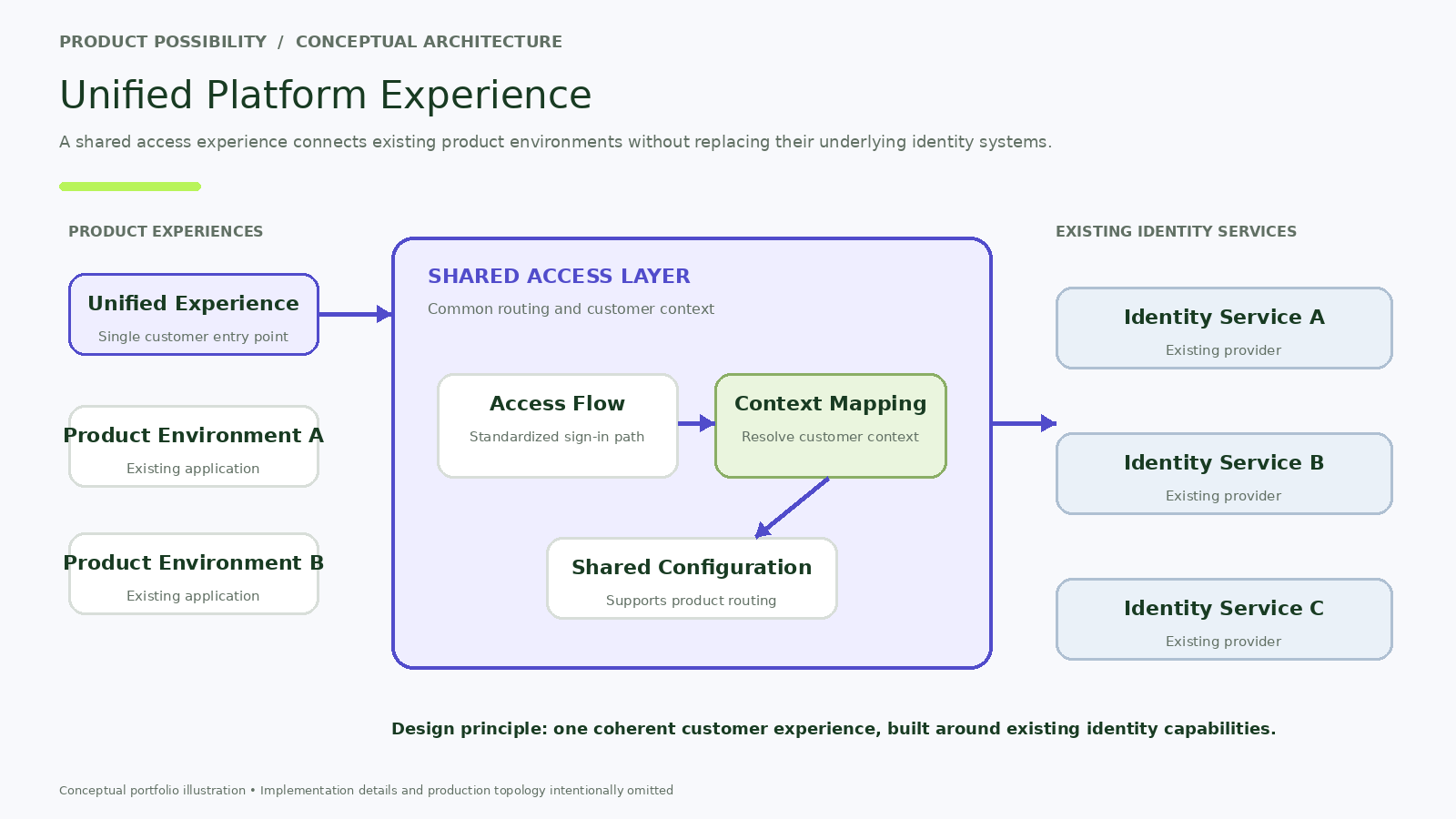
- Routing to the three existing authentication paths.
- A unified homepage and dashboard bringing together product tasks and help resources.
Longer-term direction
- Deeper platform navigation.
- Further integration of product experiences.
- Additional account, role, and workflow alignment.
Key decisions
- Delivered a facade identity architecture: an abstraction layer between client applications and the three existing identity systems, rather than replacing them.
- The facade handles the client-facing authorization flow, resolves customer context, and brokers sign-in to the right existing identity provider. It was implemented and delivered, not just proposed.
Tradeoffs
- Deliberately did not consolidate every user role, account management workflow, or reporting capability in the initial delivery.
- Chose an abstraction layer over a full rebuild to deliver customer value within real resource constraints.
Outcomes
Results of team work. Measured outcomes are kept separate from expected benefits.
33x
Growth in active cross-product customers, from 3 to 100 in one year
How it was measured
- Usage metric: customers actively using more than one product.
- The work established a foundation for a more cohesive multi-product experience, and showed that meaningful integration does not always require complete system consolidation.
Lessons
- The best architecture is not always a complete rebuild.
- Technical constraints can create opportunities for more creative product solutions.
- Cross-product initiatives need alignment on both customer experience and underlying system realities.
- A strong MVP balances immediate value with the longer-term platform vision.
- Product leaders need to understand enough architecture to make informed tradeoffs and challenge assumptions.
Supporting visuals